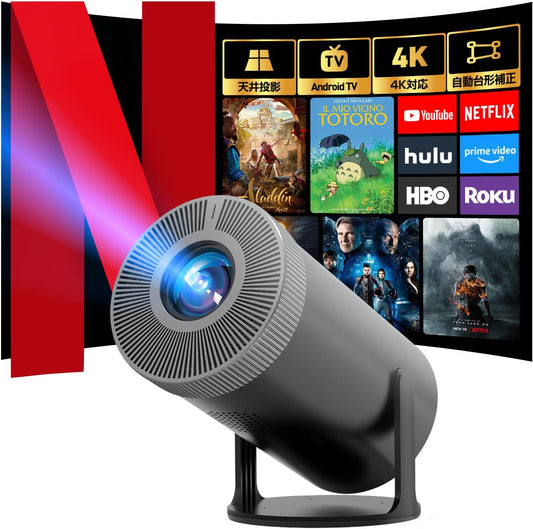

Which is cheaper, a TV or a projector?
Share
In a time of rising energy prices, reducing household utility bills is an urgent priority. Since viewing devices are used daily, the difference in their power consumption has a significant impact on monthly electricity bills. Which should you choose to save on electricity: an LED TV or a projector? This article thoroughly compares the power consumption data for both, and introduces actual electricity bill calculations and energy-saving techniques.
The real difference seen in power consumption data
The power consumption of LED TVs and projectors varies greatly depending on the model, but here are some general ranges:
Projector : 100W to 300W
These figures are based on measurements made in accordance with Japan's energy-saving standard, JIS C 8201-3-1. While the energy-saving performance of new products has improved in recent years, the general trend is that the larger the screen size, the greater the power consumption.
How much does the actual electricity bill differ?
So, how much will your electricity bill actually be different? We calculated the monthly electricity bill for watching for three hours a day, using Tokyo Electric Power Company's electricity rate as of April 2025 (28 yen/kWh).
| device | Power consumption | Daily usage | Monthly usage | Monthly electricity bill |
|---|---|---|---|---|
| LED TV | 50W | 0.15kWh | 4.5kWh | 126 yen |
| LED TV | 100W | 0.3kWh | 9kWh | 252 yen |
| LED TV | 150W | 0.45kWh | 13.5kWh | 378 yen |
| projector | 100W | 0.3kWh | 9kWh | 252 yen |
| projector | 200W | 0.6kWh | 18kWh | 504 yen |
| projector | 300W | 0.9kWh | 27kWh | 756 yen |
Save even more on your electricity bill with energy-saving techniques!
In actual use, you can further reduce your electricity bill by adjusting the settings and environment. Here we will introduce some effective energy-saving techniques.
Which one should I choose?
By comparing the electricity costs of a television and a projector, we can reach the following conclusions:
- If you only need a small screen : LED TVs (50-100W) are the most economical
- If you want a large screen : If you choose a 100W energy-saving projector model, you can watch on the same electricity bill as an LED TV.
- Energy-saving performance : Utilizing the power-saving features of the Aestiquo projector
It is important to make a comprehensive selection based on factors other than electricity costs, such as screen size, viewing distance, and installation location. With energy prices rising, choosing equipment with excellent energy-saving performance is also economical in the long run.
For detailed energy conservation information, please see the Energy Conservation Information website of the Agency for Natural Resources and Energy .
For more information about Aestiquo products, please refer to the Aestiquo FAQ page and guidance video .